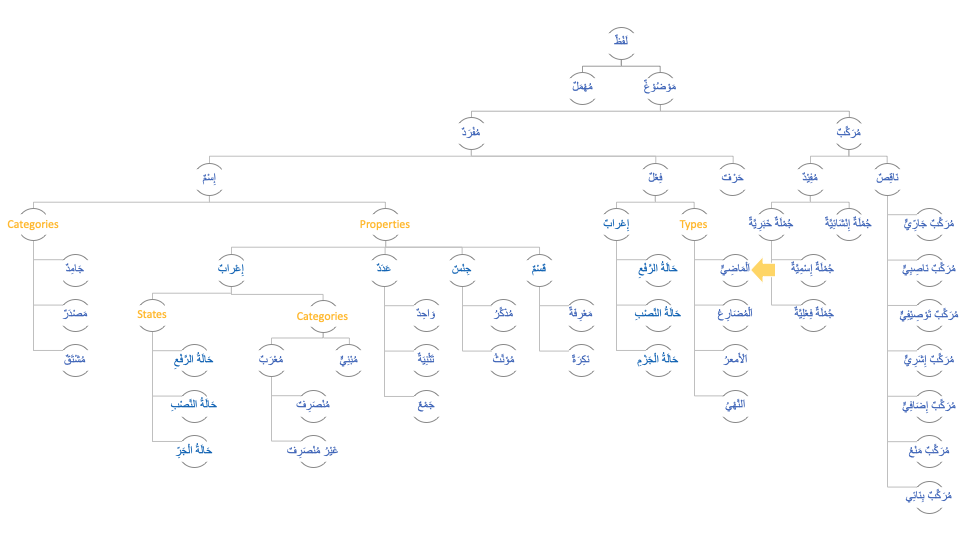
اَلْفِعْلُ الْمَاضِيُّ Introduction
In this module we will explore the اَلْفِعْلُ الْمَاضِيُّ, which is a مُفْرَدٌ(كَلِمَةٌ).
The اَلْفِعْلُ الْمَاضِيُّ is a past tense verb, which in Arabic is used to describe actions that are finished.
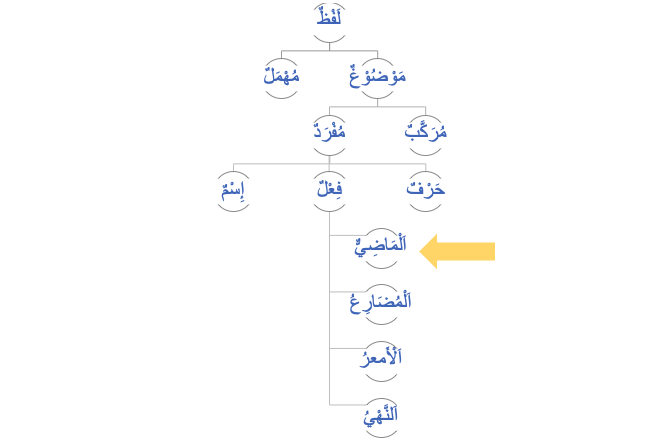

A فِعْلٌ [Fi’l] refers to an action or a state. It has a tense (past, present or future).
The plural for فِعْلٌ is أَفْعَالٌ.
Examples of Top Ten mentioned in the Quran:
- قَالَ : he said
- كَانَ : to be, was
- ءَامَنَ/ آمَنَ : he believed
- عَلِمَ : he knew
- جَعَلَ : he made
- كَفَرَ : he disbelieved
- جَاءَ : he came
- عَمِلَ : he did/he worked
- آتَى/ءَاتَى : he gave
- رَءَا / رَأَى : he saw
You may think a فِعْلٌ is a verb, as described in the English language. However, there is a fundamental difference between the two. A verb in English is defined as a word that conveys an action, such as ‘ate’, ‘reads’, ‘will sleep’ etc, However, in the aforementioned examples we do not know who did the action. i.e. who ate? who is reading? who will sleep?. However, in Arabic the فِعْلٌ has the action but also the doer (in the form of a pronoun) inside it.

Interesting point to note, a فِعْلٌ is considered a complete sentence on its own, because it not only tells you what was done, but also who did it. Thus the simplest جُمْلَةٌ فِعْلِيَّةٌ (Verb Sentence) is simply a فِعْلٌ on its own.