
Introduction
In this module we will be discussing the Arabic Letters (ٱلْحُرُوفُ ٱلْعَرَبِيَّةُ).
Consonants
There are 28 consonant letters in the Arabic Language (اؐللُّغَةُ اؐلعَرَبِيَّةُ) :
ء ب ت ث ج ح خ د ذ ر ز س ش ص ض ط ظ ع غ ف ق ك ل م ن ه و ي
Consonants are letters that make a sound by stopping the air for a moment with your tongue, lips, or throat. For example, when you say ‘ب’ (‘b’), your lips close and then open to let the sound out.
In Arabic most letters are consonants. The only letters that are not consonants are called vowels.
Vowels
In Arabic, vowels are called Harakaat (حركات), which means ‘movements’. They are small marks placed on consonants, and are referred to as ‘short vowels‘.
The short vowels are:
- Fathah (ـَ) corresponding to the sound ‘a’
- Kasrah (ـِ) corresponding to the sound ‘i’
- Dammah (ـُ) corresponding to the sound ‘u’
Arabic also has long vowels. Long vowels are pronounced for about twice as long as short vowels:
- Alif (ا) corresponding to the sound ‘aa’
- Yā (ي) corresponding to the sound ‘ii’
- Wāw (و) corresponding to the sound ‘uu’
Changing a vowel can change the meaning of a word.
Sound
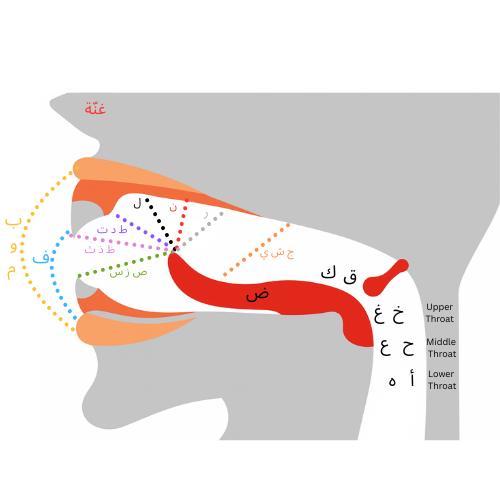
In this module we will be discussing the sound each letter makes and its makhraj (مَخْرَج).
In Arabic, makhraj (مَخْرَج) means “exit” or “point of articulation.” It refers to the place in the mouth, throat or nasal where a sound is produced. Each Arabic letter has its own makhraj (مَخْرَج). Below diagram illustrates the makhraj (مَخْرَج) for each Arabic letter.
Form
We will also be exploring the written form. Each letter can appear up to four unique forms, depending on where it sits in a word:
- Isolated (standing alone)
- Initial (at the beginning of a word)
- Medial (in the middle)
- Final (at the end)
Treasure

Vocabulary is a key part to understanding Arabic, it is the treasure you collect on your journey to understanding the Arabic Language. Therefore this course starts building your vocabulary right from the outset.
The words provided in this course are drawn from some of the most frequently used words in the Qur’an.
So let us start with your very first word.
مَثَل
Example
It is mentioned in the Quran 88 times.
The word مَثَل is mentioned in the following Quranic verse:
مَثَلُ ٱلْفَرِيقَيْنِ كَٱلْأَعْمَىٰ وَٱلْأَصَمِّ وَٱلْبَصِيرِ وَٱلسَّمِيعِ ۚ هَلْ يَسْتَوِيَانِ مَثَلًا ۚ أَفَلَا تَذَكَّرُونَ
The example of these two parties is that of the blind and the deaf, compared to the seeing and the hearing. Are they equal in comparison? Will you not then be mindful?
[11:24]
Memorise
مَثَل  : Example

Whenever you read the Qur’an and notice a word you’ve learned, underline it. It’s a fun way to see your progress and helps you remember it even better!